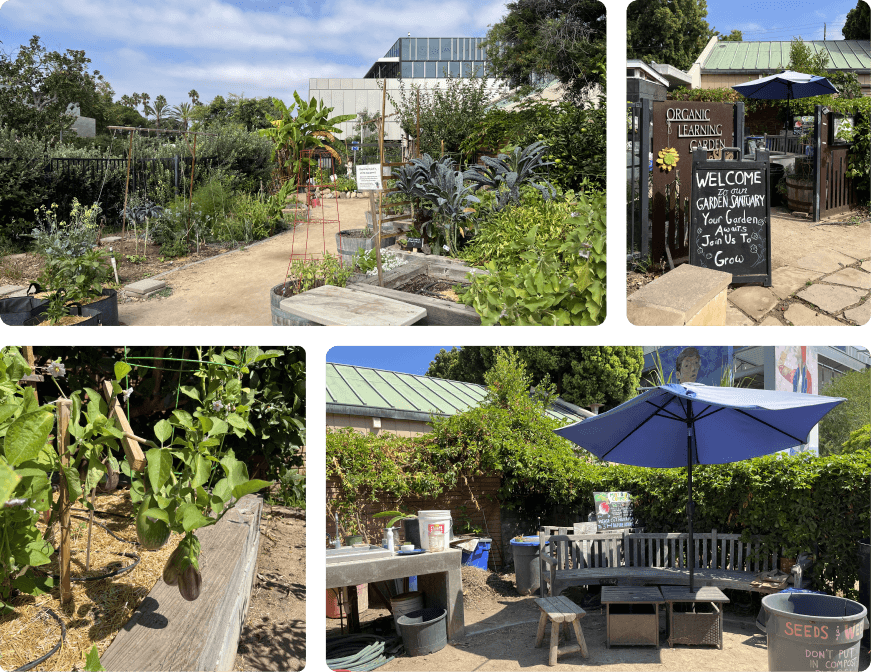
Organic Learning Garden

A centralized website and spatial redesign to transform the campus garden into a third place.

Product Design

UX/UI

Web Design

Organic Learning Garden

A centralized website and spatial redesign to transform the campus garden into a third place.

Product Design

UX/UI

Web Design

Organic Learning Garden

A centralized website and spatial redesign to transform the campus garden into a third place.

Product Design

UX/UI

Web Design

Project Brief

The Santa Monica College (SMC) Organic Learning Garden is a small campus space with strong community and educational value, but suffering from low visibility, fragmented communication, and limited physical capacity. This project was part of an anthropology course focused on designing third places on campus—social spaces that support connection and belonging, separate from home and workplace. Our team developed a shared vision supported by multiple design interventions; my main contribution was a hi-fi prototype of a website to clarify the garden’s access and opportunities.

Project Type

Academic (Santa Monica College, IxD)

Role

Product Designer

Timeline

Fall 2025 (16 weeks)

Project Brief

The Santa Monica College (SMC) Organic Learning Garden is a small campus space with strong community and educational value, but suffering from low visibility, fragmented communication, and limited physical capacity. This project was part of an anthropology course focused on designing third places on campus—social spaces that support connection and belonging, separate from home and workplace. Our team developed a shared vision supported by multiple design interventions; my main contribution was a hi-fi prototype of a website to clarify the garden’s access and opportunities.

Project Type

Academic (Santa Monica College, IxD)

Role

Product Designer

Timeline

Fall 2025 (16 weeks)

Project Brief

The Santa Monica College (SMC) Organic Learning Garden is a small campus space with strong community and educational value, but suffering from low visibility, fragmented communication, and limited physical capacity. This project was part of an anthropology course focused on designing third places on campus—social spaces that support connection and belonging, separate from home and workplace. Our team developed a shared vision supported by multiple design interventions; my main contribution was a hi-fi prototype of a website to clarify the garden’s access and opportunities.

Project Type

Academic (Santa Monica College, IxD)

Role

Product Designer

Timeline

Fall 2025 (16 weeks)

Problem

Despite sitting in a high-traffic area, most students don’t know the garden open to them, what it’s for, or how to get involved, and the physical space itself feels limiting for existing members.

Insights

The garden is already a third place for a small, dedicated group; students not currently involved are also interested. Clearer information paired with visions for food access, shared spaces, and education, would allow it to scale across campus.

Solution

A connected system of visual identity, speculative space concepts, events and certificates, and a comprehensive website that centralizes information, surfaces opportunities, and supports the garden’s existing community.

Outcome

Our Anthropology professors, who are also garden advisors, were highly impressed by the thoughtfulness and feasibility of the proposal and expressed strong interest in pitching it to the school.

Problem

Despite sitting in a high-traffic area, most students don’t know the garden open to them, what it’s for, or how to get involved, and the physical space itself feels limiting for existing members.

Insights

The garden is already a third place for a small, dedicated group; students not currently involved are also interested. Clearer information paired with visions for food access, shared spaces, and education, would allow it to scale across campus.

Solution

A connected system of visual identity, speculative space concepts, events and certificates, and a comprehensive website that centralizes information, surfaces opportunities, and supports the garden’s existing community.

Outcome

Our Anthropology professors, who are also garden advisors, were highly impressed by the thoughtfulness and feasibility of the proposal and expressed strong interest in pitching it to the school.

Problem

Despite sitting in a high-traffic area, most students don’t know the garden open to them, what it’s for, or how to get involved, and the physical space itself feels limiting for existing members.

Insights

The garden is already a third place for a small, dedicated group; students not currently involved are also interested. Clearer information paired with visions for food access, shared spaces, and education, would allow it to scale across campus.

Solution

A connected system of visual identity, speculative space concepts, events and certificates, and a comprehensive website that centralizes information, surfaces opportunities, and supports the garden’s existing community.

Outcome

Our Anthropology professors, who are also garden advisors, were highly impressed by the thoughtfulness and feasibility of the proposal and expressed strong interest in pitching it to the school.

Research

Overview of Current Garden

Overview of Current Garden

Overview of Current Garden

The Organic Learning Garden is a fenced, 1,200 sq ft space adjacent to the Art Complex, surrounded by heavy foot traffic, shaded seating areas, and key campus amenities including the bookstore, bodega, cafeteria, and student services.
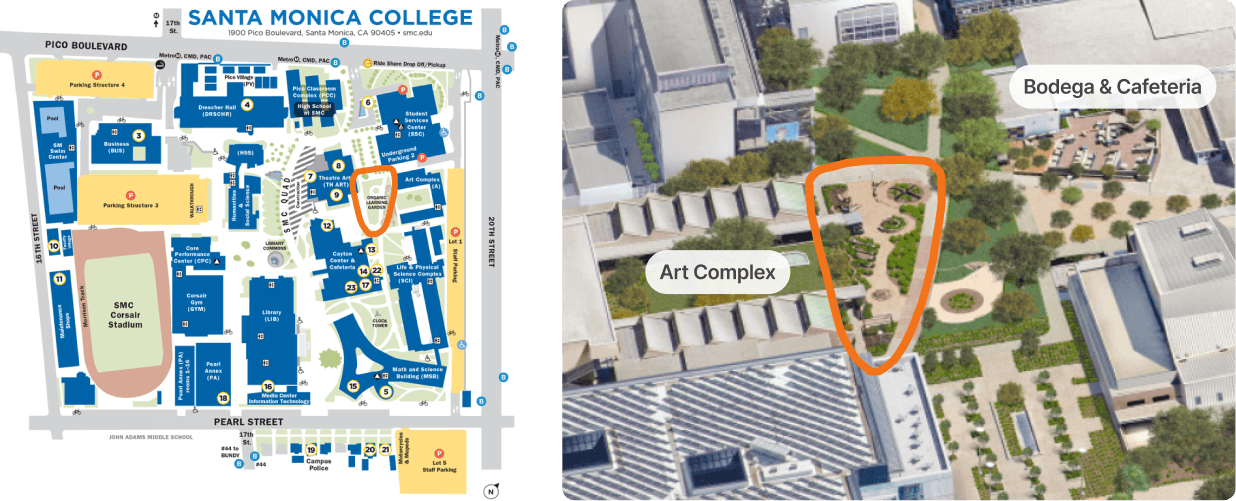
Location of the Organic Learning Garden on SMC’s main campus.

Location of the Organic Learning Garden on SMC’s main campus.

Location of the Organic Learning Garden on SMC’s main campus.

Fieldwork Observations

A strong community exists, but only if someone is there to explain it.

Fieldwork Observations

A strong community exists, but only if someone is there to explain it.

Fieldwork Observations

A strong community exists, but only if someone is there to explain it.

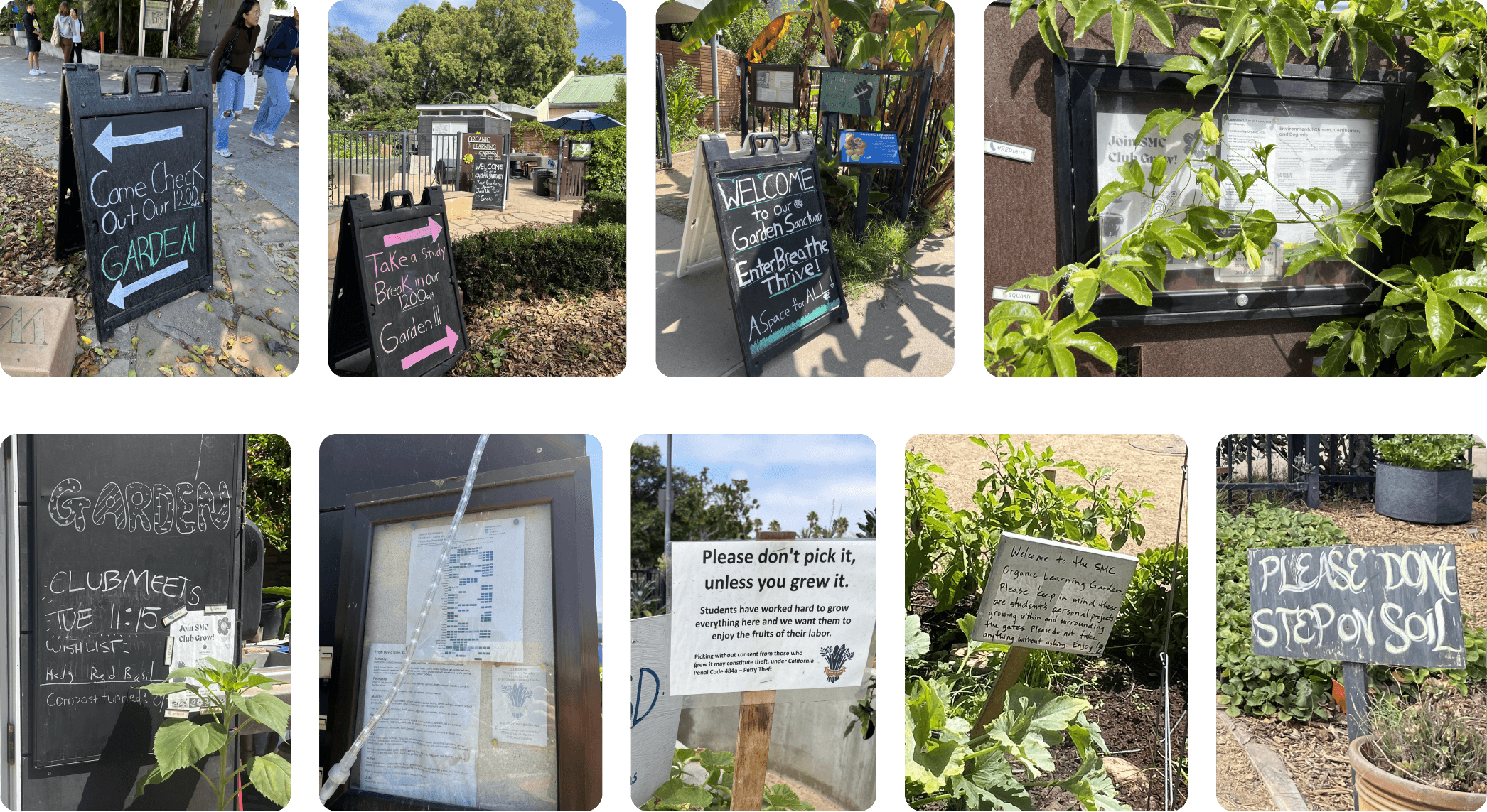
We conducted on-site observations at different times of day and week, documenting spatial conditions, signage, and foot traffic, and spoke with garden members, staff, and casual passersby. Although 70-80 people passed by within 20 minutes, very few noticed or entered the garden. When members were present, the space felt welcoming, but without them, it felt confusing and closed off due to the lack of information and conflicting signage. Conversations with members and our own experience showed that currently, discovering the garden depends largely on chance encounters, making word of mouth the primary path to participation.
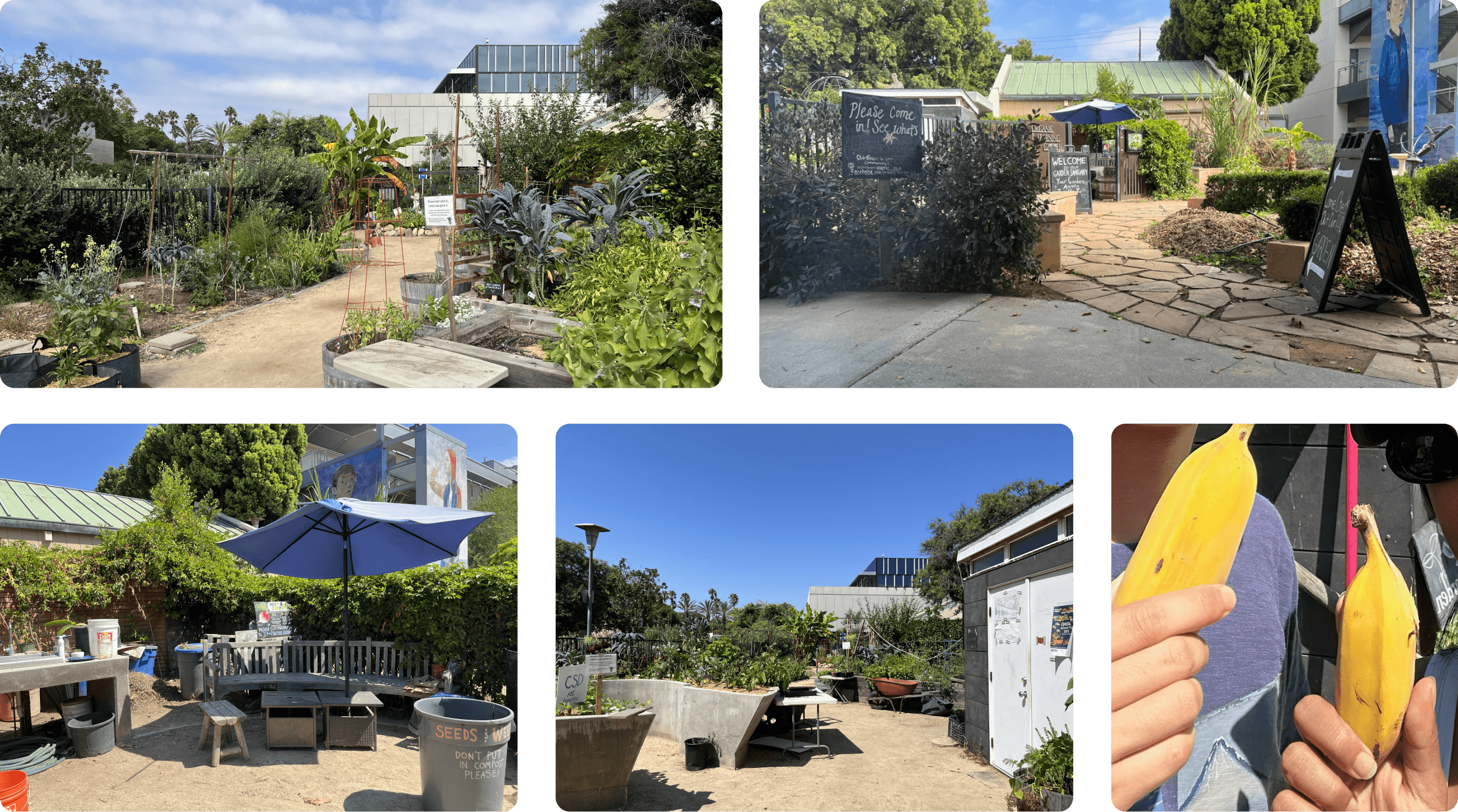
General view of the garden—productive and full of greenery. Ruby, a garden fellow, even shared freshly harvested bananas with us.

General view of the garden—productive and full of greenery. Ruby, a garden fellow, even shared freshly harvested bananas with us.

General view of the garden—productive and full of greenery. Ruby, a garden fellow, even shared freshly harvested bananas with us.

Exterior signage attempts to invite people in, but interior signs emphasize restrictions without clear guidance. Club information is easy to miss, obscured by plants, or outdated.

Exterior signage attempts to invite people in, but interior signs emphasize restrictions without clear guidance. Club information is easy to miss, obscured by plants, or outdated.

Exterior signage attempts to invite people in, but interior signs emphasize restrictions without clear guidance. Club information is easy to miss, obscured by plants, or outdated.

Literature Review & Desktop Research

Campus gardens are proven third places when participation is visible and supported.

Literature Review & Desktop Research

Campus gardens are proven third places when participation is visible and supported.

Literature Review & Desktop Research

Campus gardens are proven third places when participation is visible and supported.

Research on third places and community gardens reinforced the garden’s value for sustainability education, food access, and social and cultural connection, especially amid rising loneliness. UX strategy research and nonprofit case studies emphasized designing for activities, touchpoints, and participation rather than assuming a single path of engagement. However, desktop research uncovered a major disconnect: the official SMC garden webpage and social media were outdated, fragmented, and unclear, directly contributing to low awareness. This confirmed that while the garden aligns with proven third place models, weak communication limits its reach and impact.
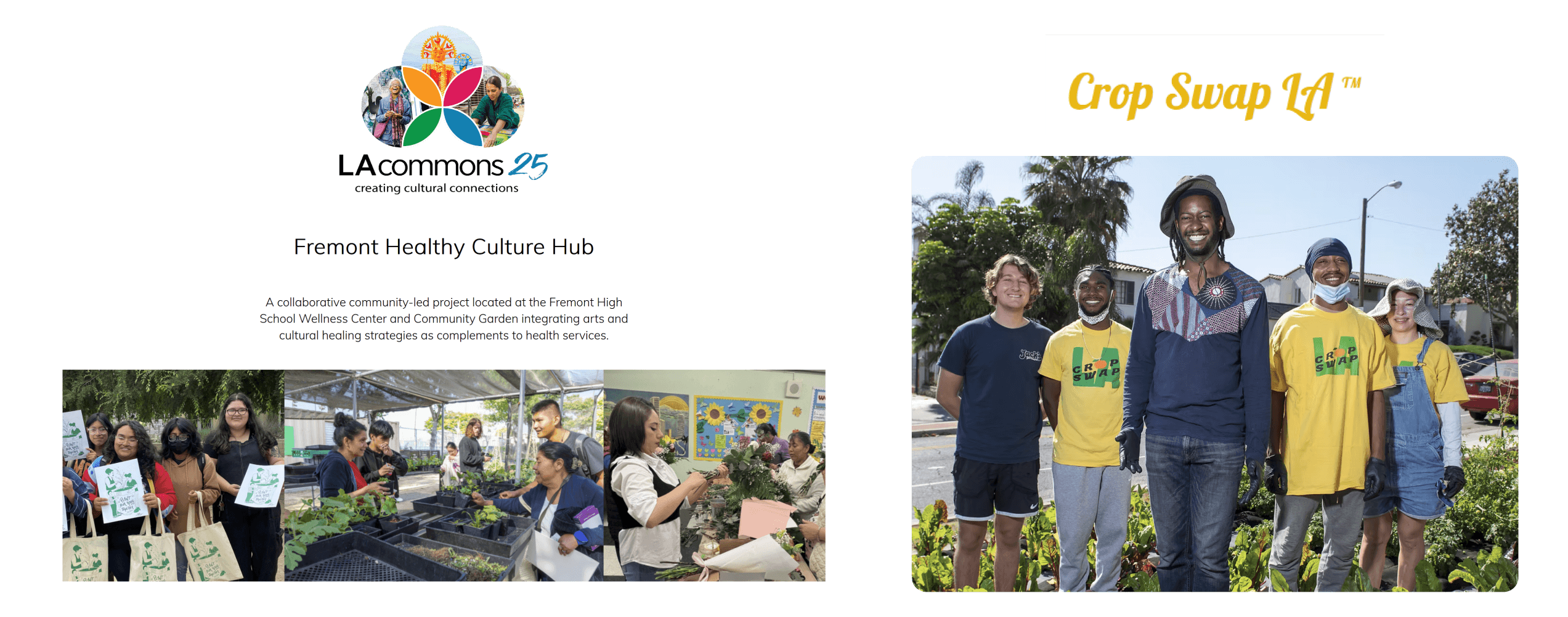
We referenced existing community gardens, food access, and sustainability programs.

We referenced existing community gardens, food access, and sustainability programs.

We referenced existing community gardens, food access, and sustainability programs.

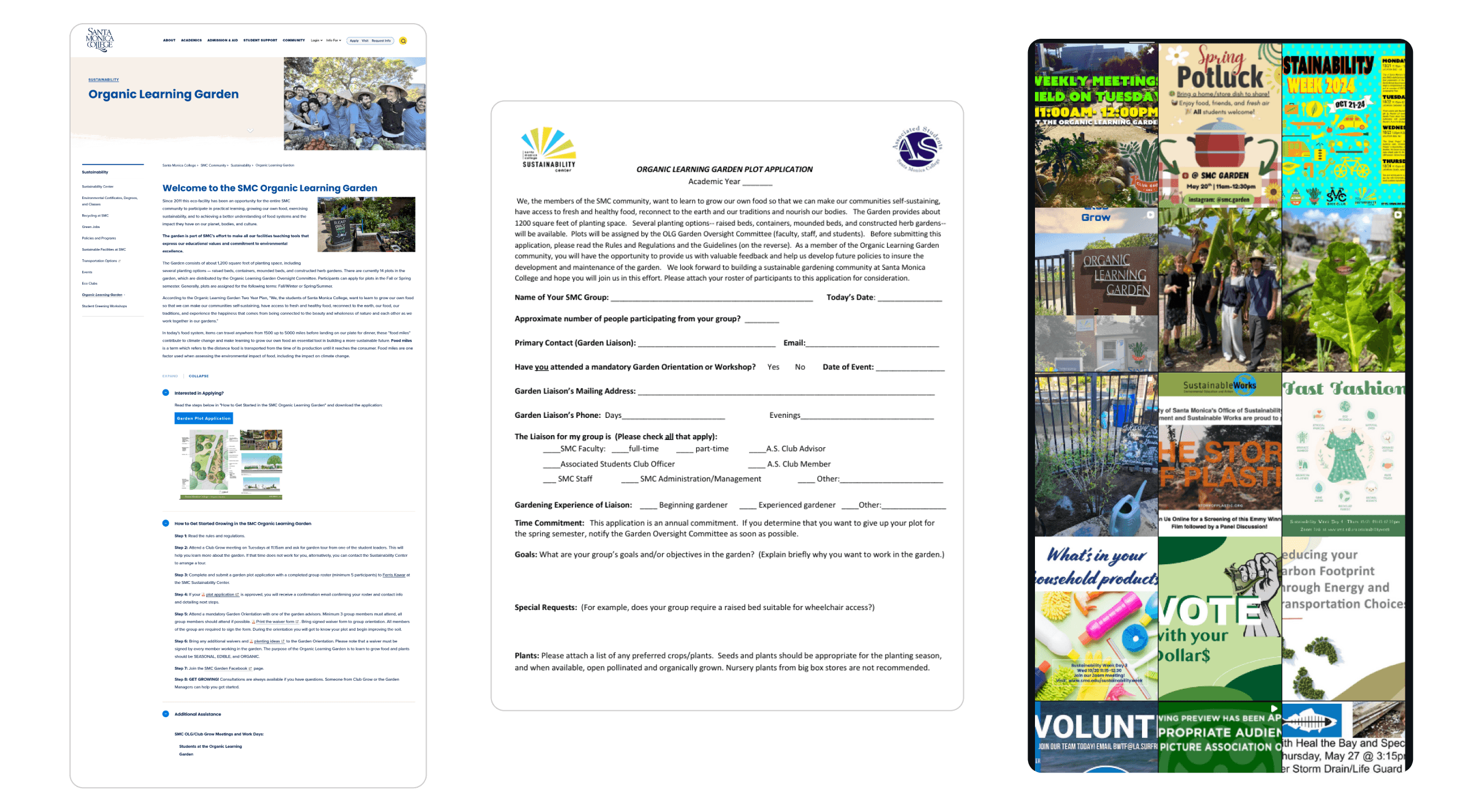
The official SMC website’s garden page is difficult to find and lacks information about current activity or community. The plot application uses an inconvenient PDF process, and the club’s Instagram is outdated.

The official SMC website’s garden page is difficult to find and lacks information about current activity or community. The plot application uses an inconvenient PDF process, and the club’s Instagram is outdated.

The official SMC website’s garden page is difficult to find and lacks information about current activity or community. The plot application uses an inconvenient PDF process, and the club’s Instagram is outdated.

Interviews

The garden is a deeply meaningful space for connection, education, and food production, with potential to become a greater campus resource.

Interviews

The garden is a deeply meaningful space for connection, education, and food production, with potential to become a greater campus resource.

Interviews

The garden is a deeply meaningful space for connection, education, and food production, with potential to become a greater campus resource.

Garden members described the space as peaceful, welcoming, and deeply meaningful for learning, sharing food, and mental well-being. At the same time, they noted issues such as limited space and facilities, ineffective organization, and the lack of public awareness. Faculty advisors and directors framed the garden as a long-term campus resource, with a vision for an edible campus that integrates food production, education, certificates, and basic needs support over a 5-10 year timeline. They emphasized that student advocacy is essential, while institutional approvals, funding, and cross-department coordination remain the primary constraints to scale.
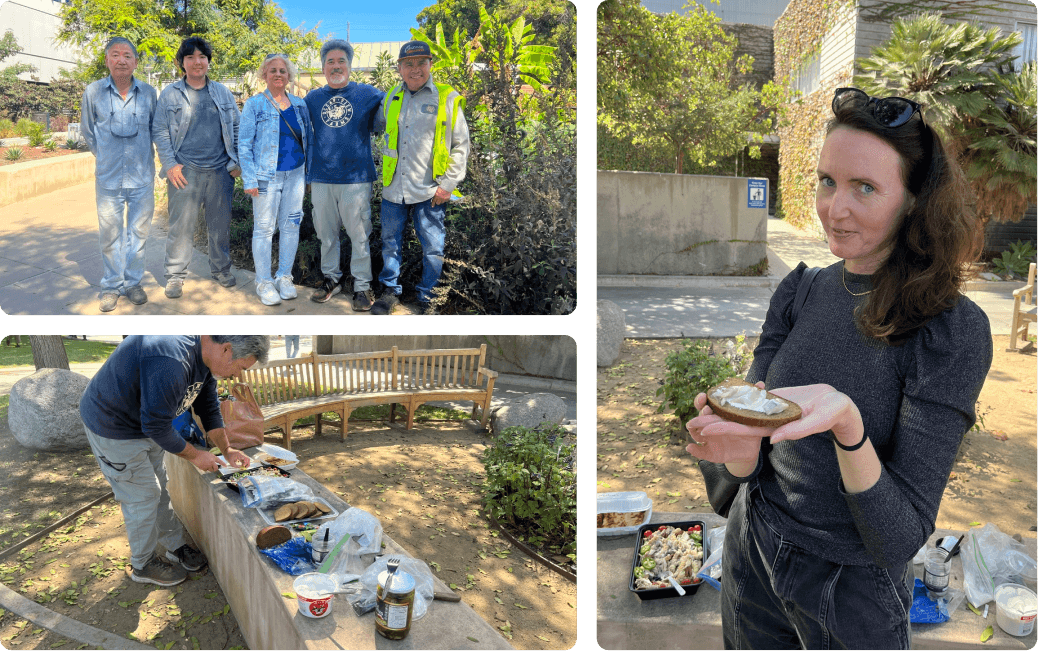
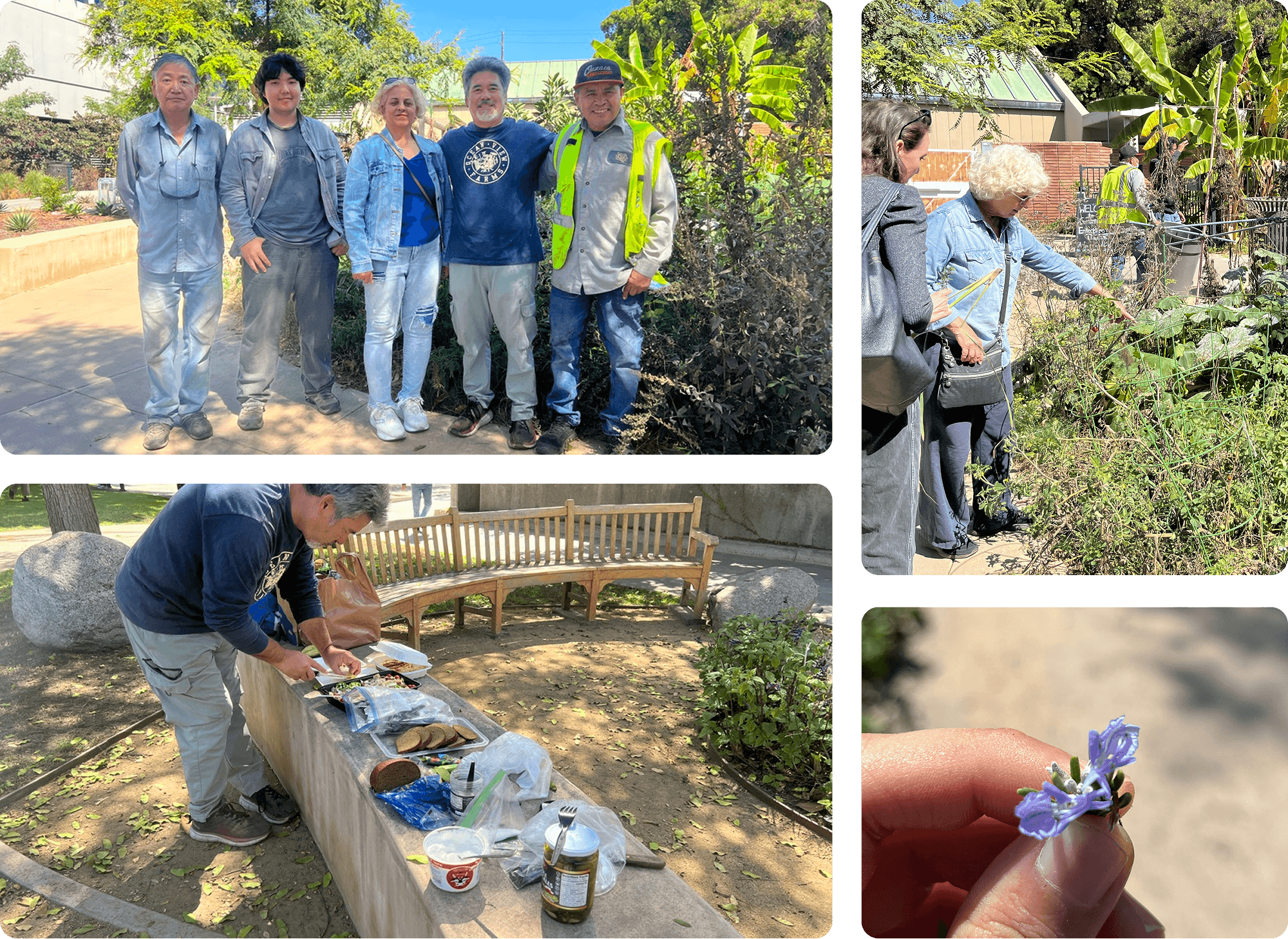
We unexpectedly discovered the Wednesday community potluck group, made up of garden members, alumni, community members, and SMC maintenance workers.

We unexpectedly discovered the Wednesday community potluck group, made up of garden members, alumni, community members, and SMC maintenance workers.

We unexpectedly discovered the Wednesday community potluck group, made up of garden members, alumni, community members, and SMC maintenance workers.

Survey

Students strongly value the garden as a third space for quiet study and hands-on learning, with 77% of those previously unaware expressing interest.

Survey

Students strongly value the garden as a third space for quiet study and hands-on learning, with 77% of those previously unaware expressing interest.

Survey

Students strongly value the garden as a third space for quiet study and hands-on learning, with 77% of those previously unaware expressing interest.

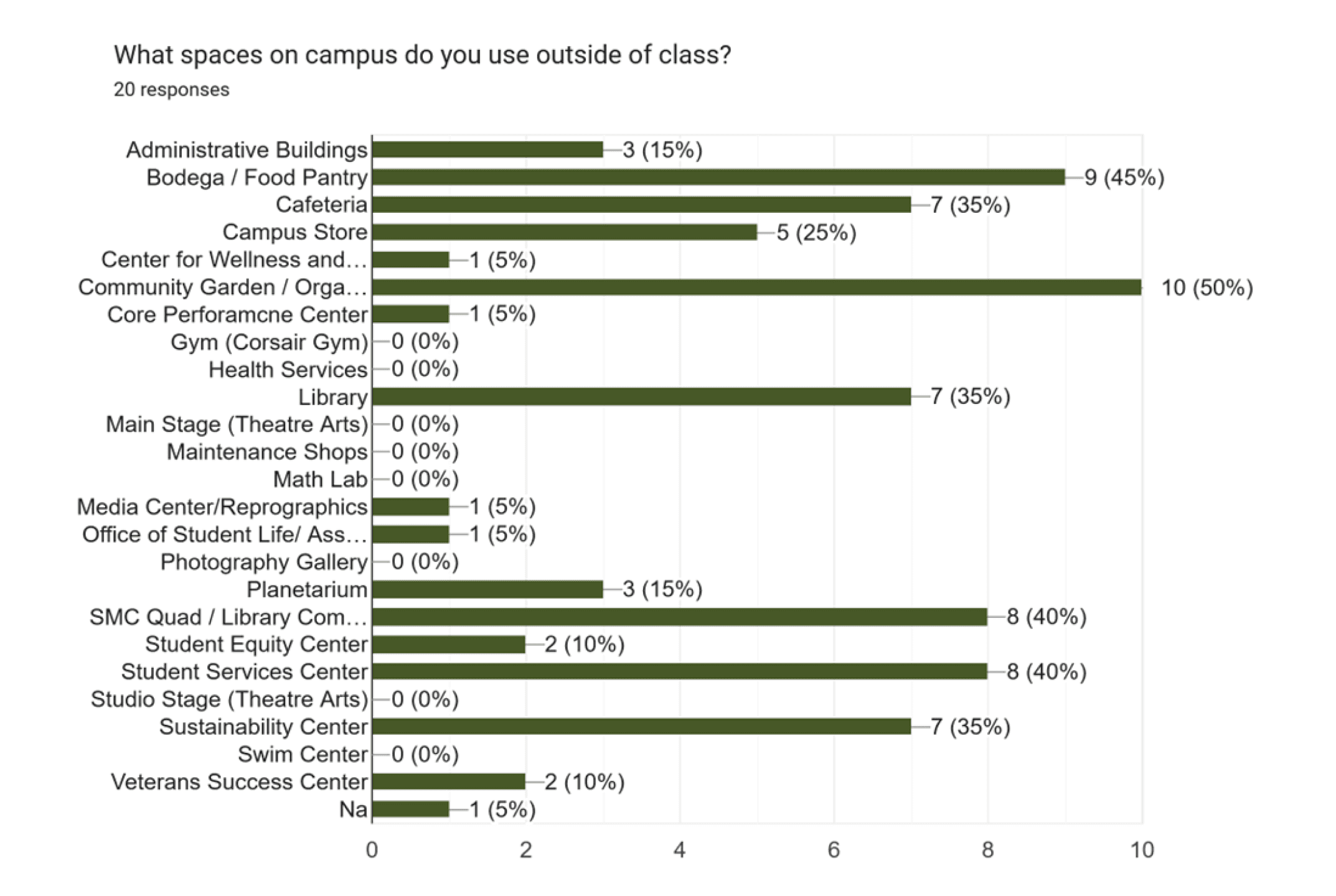
We collected 21 survey responses from garden members and the general student body to evaluate campus space usage and awareness of the garden. Students prioritized third space features like quiet study zones, workshop spaces, events and produce share, and class integration. Respondents were also highly interested in hands-on learning and community events, including “how to grow” workshops, mental health, sustainability and nutrition, soil health, indigenous plant knowledge, and cooking.
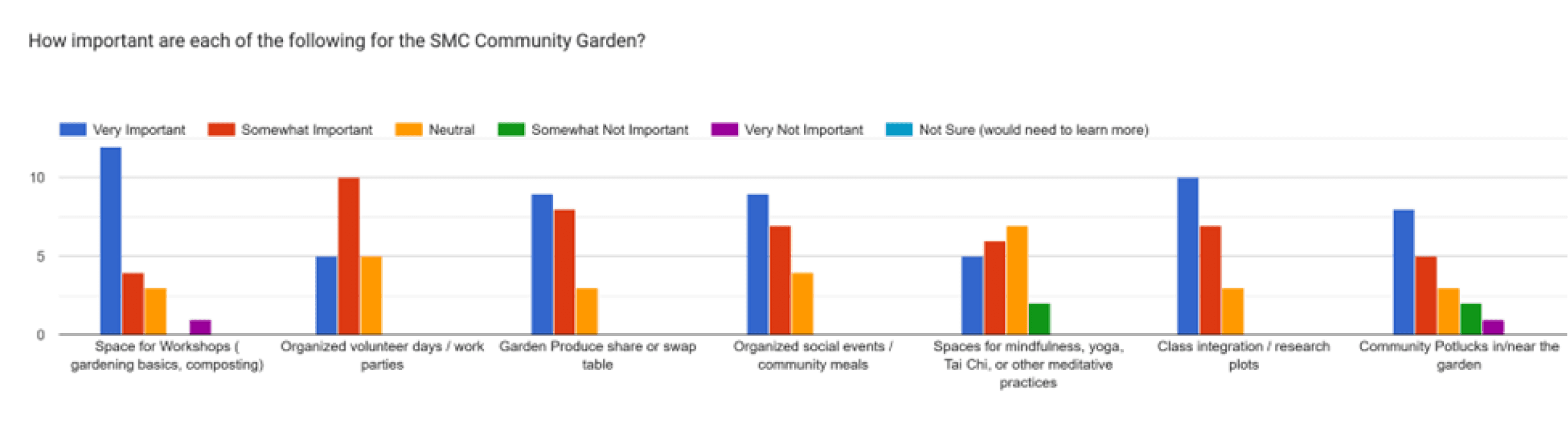
Students most value workshop spaces, class integration, food sharing, and social events.

Students most value workshop spaces, class integration, food sharing, and social events.

Students most value workshop spaces, class integration, food sharing, and social events.

Beyond the garden, respondents most frequently use the bodega, quad, cafeteria, library, student services center, and sustainability center. (Note: Most respondents were garden members.)

Beyond the garden, respondents most frequently use the bodega, quad, cafeteria, library, student services center, and sustainability center. (Note: Most respondents were garden members.)

Beyond the garden, respondents most frequently use the bodega, quad, cafeteria, library, student services center, and sustainability center. (Note: Most respondents were garden members.)

Research Synthesis

TL;DR: Information unlocks participation; space determines scale.

Research Synthesis

TL;DR: Information unlocks participation; space determines scale.

Research Synthesis

TL;DR: Information unlocks participation; space determines scale.

Research showed that while the garden already serves a small, committed community, fragmented information limits broader participation and understanding. At the same time, the garden has reached physical capacity, prompting interest in expanded space and facilities. In response, we proposed a centralized website to clarify access and opportunities, a speculative expansion concept, and long-term vision to support future growth.

Prototyping

Logo Sketches & Wireframes

Logo Sketches & Wireframes

Logo Sketches & Wireframes

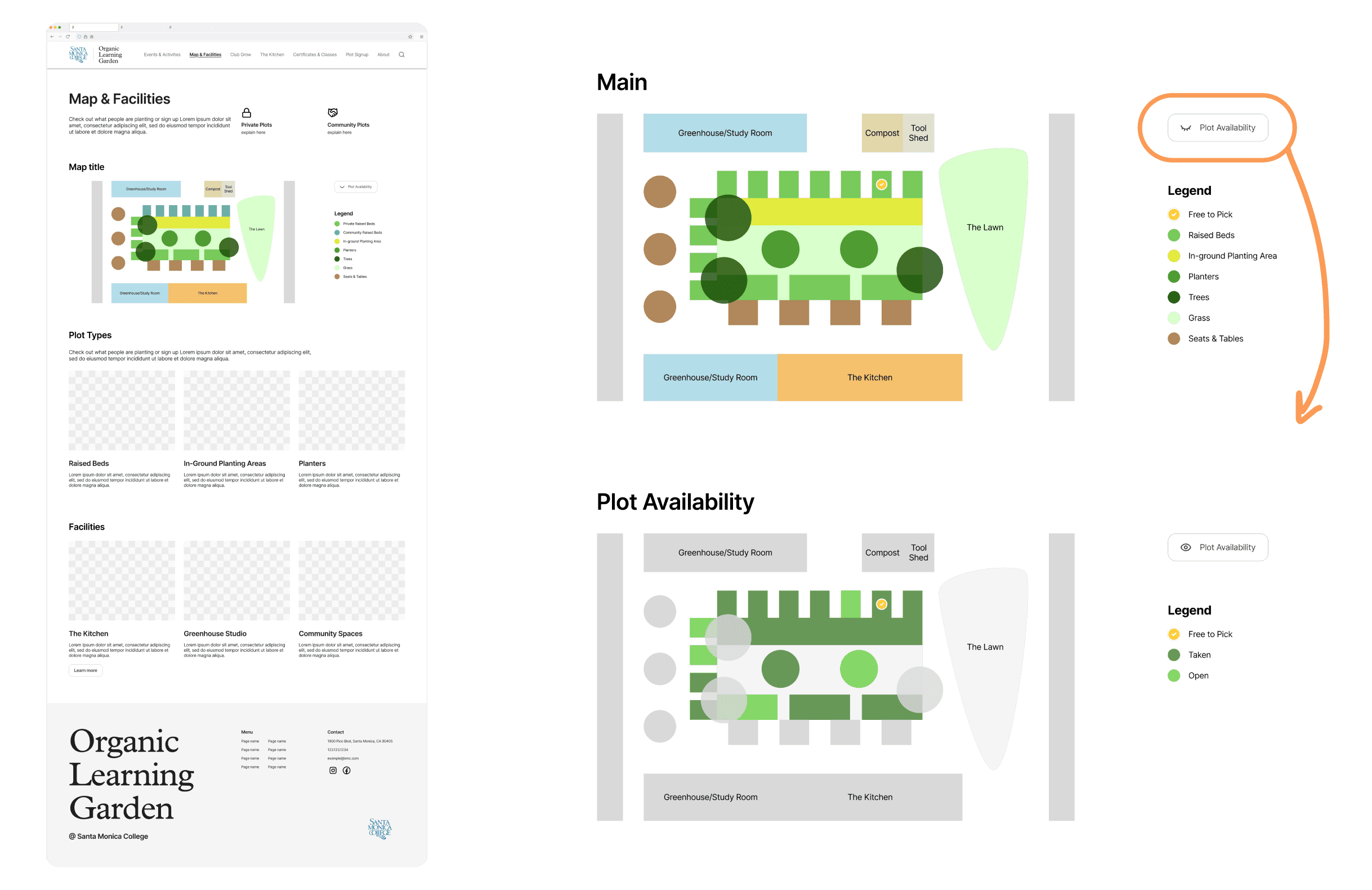
After establishing a shared team vision, I developed the logo and high-fidelity website prototype. Feedback sessions validated the “carrot” concept as the strongest visual anchor for the garden and informed improvements to the website’s information architecture. I reorganized content hierarchy for clearer storytelling, refined visual affordances for interactivity, and adjusted the layout to reduce cognitive load on text-heavy pages.
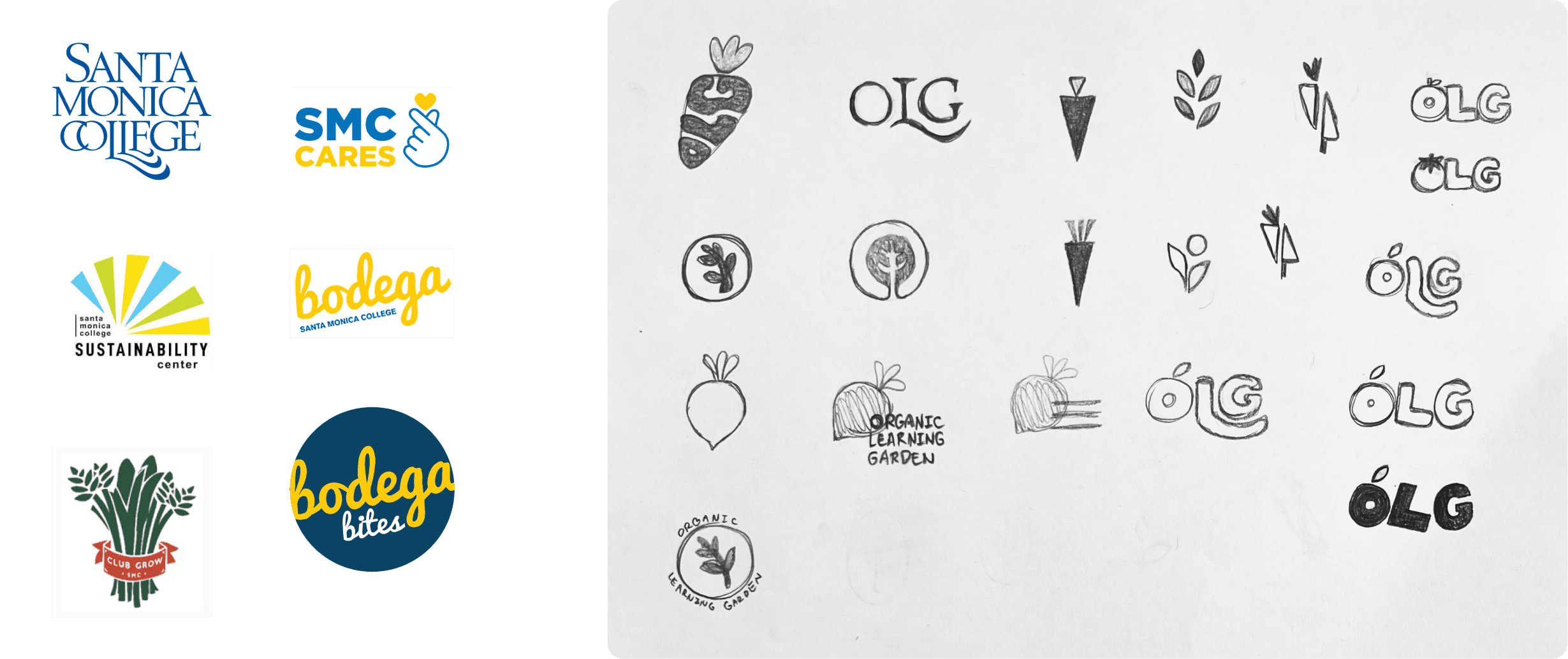
Logo references and exploratory sketches.

Logo references and exploratory sketches.

Logo references and exploratory sketches.

Initial map draft testing labeling, hierarchy, and interaction clarity.

Initial map draft testing labeling, hierarchy, and interaction clarity.

Initial map draft testing labeling, hierarchy, and interaction clarity.

Final ProductS

My First Deliverable

Logo

My First Deliverable

Logo

My First Deliverable

Logo

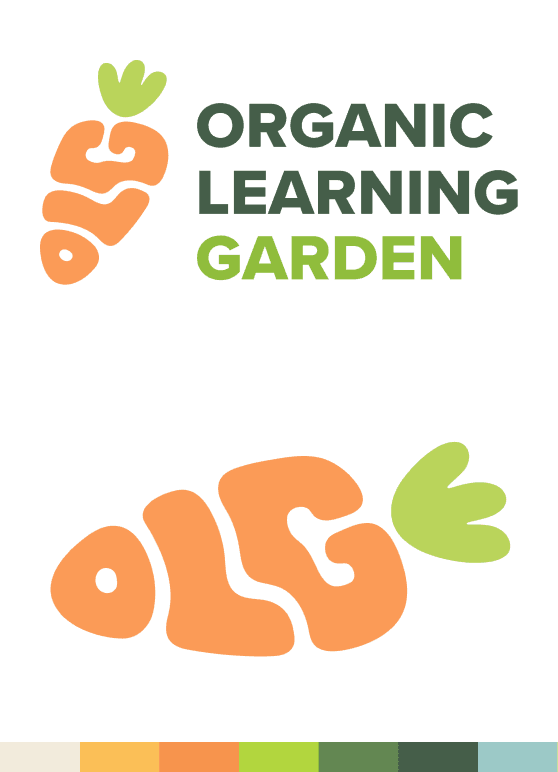
The garden lacked a visual identity, making it easy to overlook both physically and online. I designed a logo and color palette inspired by existing main SMC logo, the Sustainability Center, and Club Grow branding to feel official, familiar, and scalable across signage, web, and campus touchpoints.
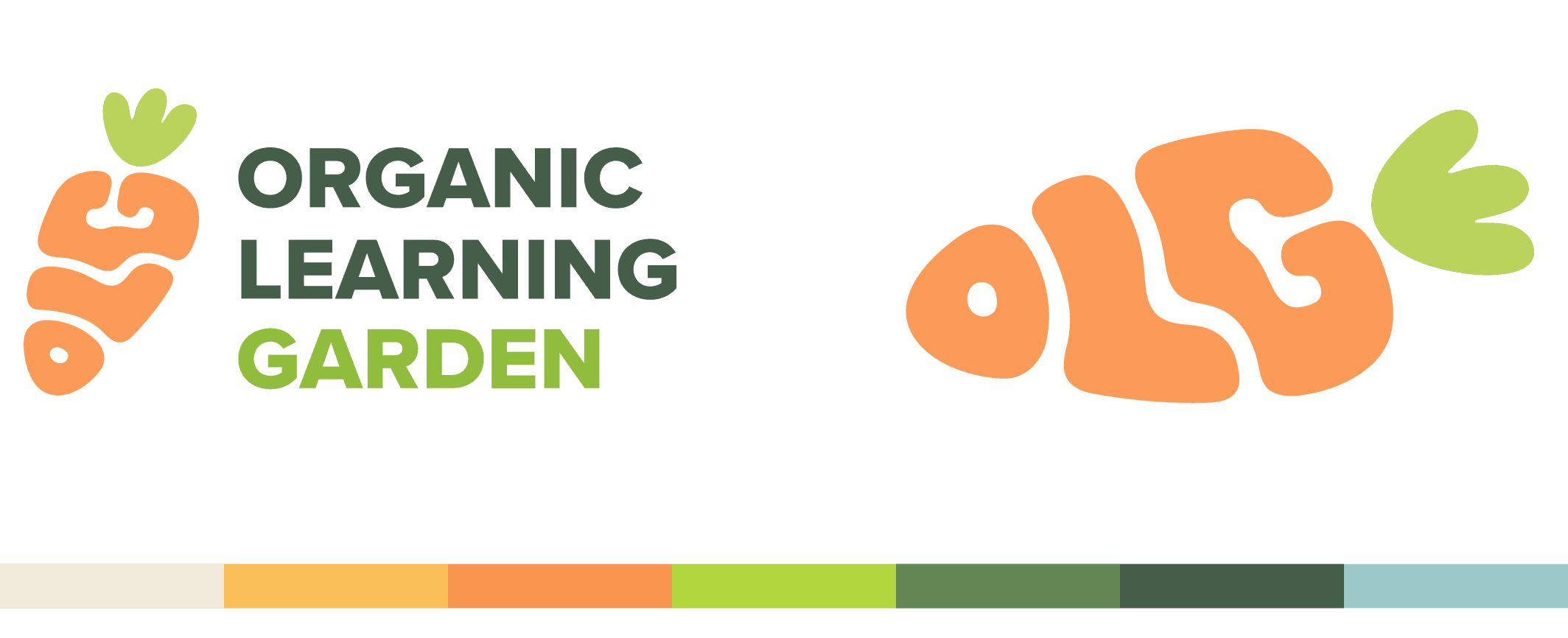
Final logo variations and color palette.

Final logo variations and color palette.

Final logo variations and color palette.

My Main Deliverable | Copywriting by Sandi Piorek

Website

My Main Deliverable | Copywriting by Sandi Piorek

Website

My Main Deliverable | Copywriting by Sandi Piorek

Website

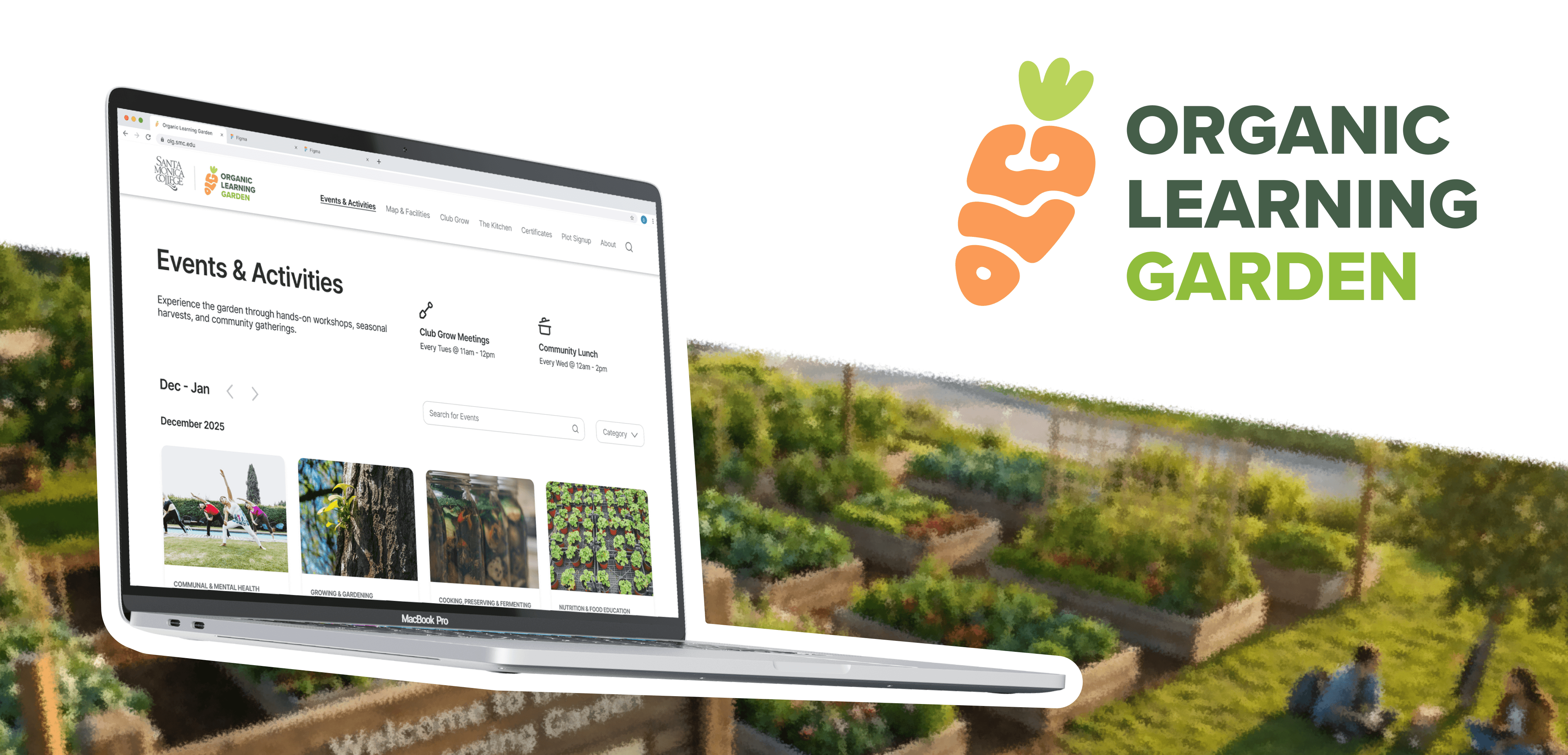
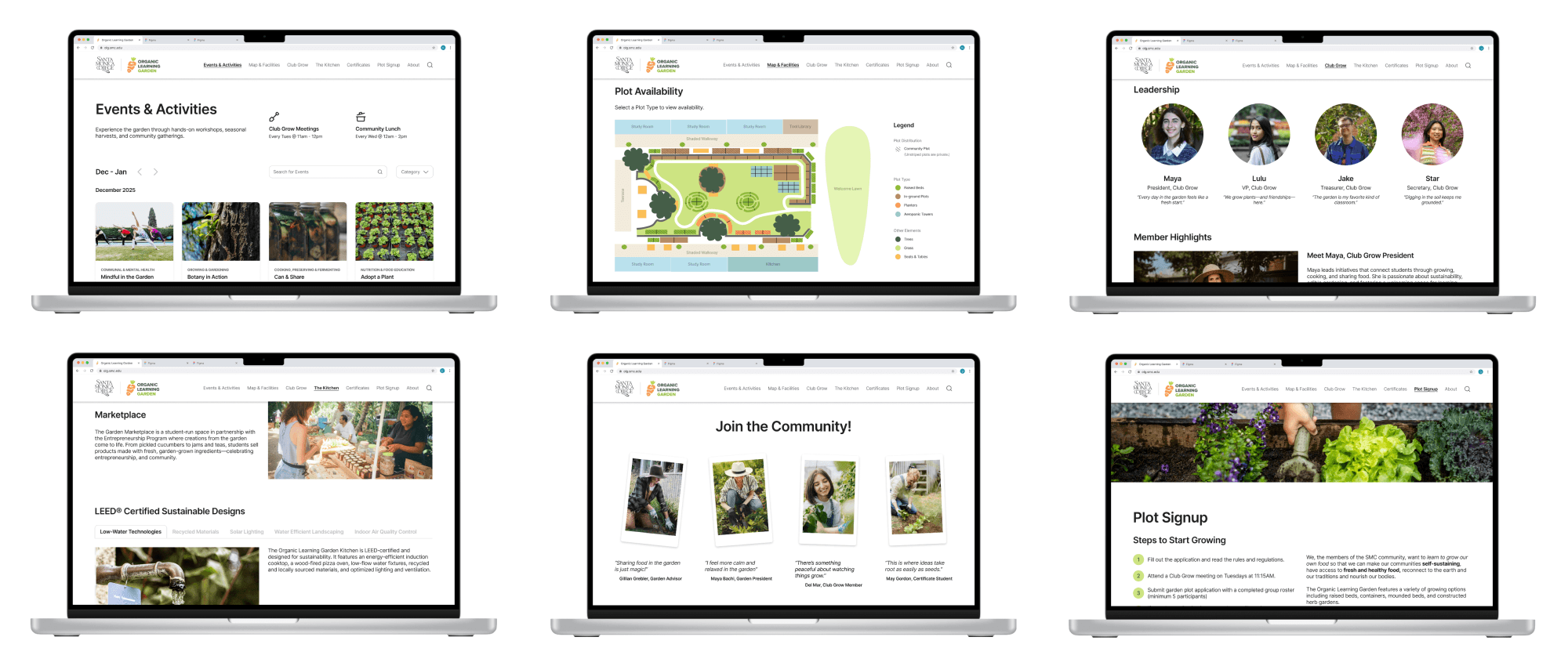
The website consolidates all garden-related information into a single platform, replacing fragmented, outdated sources while showcasing our concepts for events, facilities, and education.
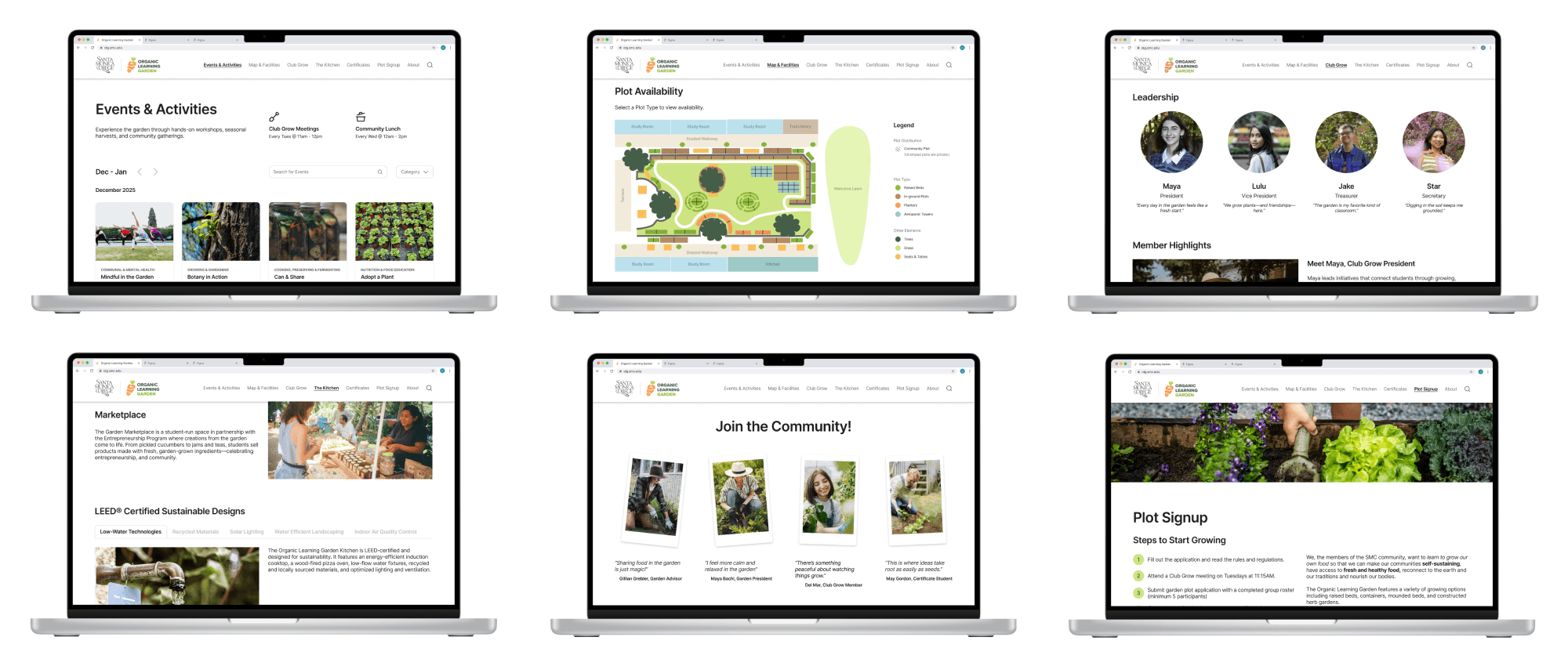
Practical information and community highlights.

Practical information and community highlights.

Practical information and community highlights.

Illustrations by Isabella Perrini

Garden Expansion & Landscape Plan

Illustrations by Isabella Perrini

Garden Expansion & Landscape Plan

Illustrations by Isabella Perrini

Garden Expansion & Landscape Plan

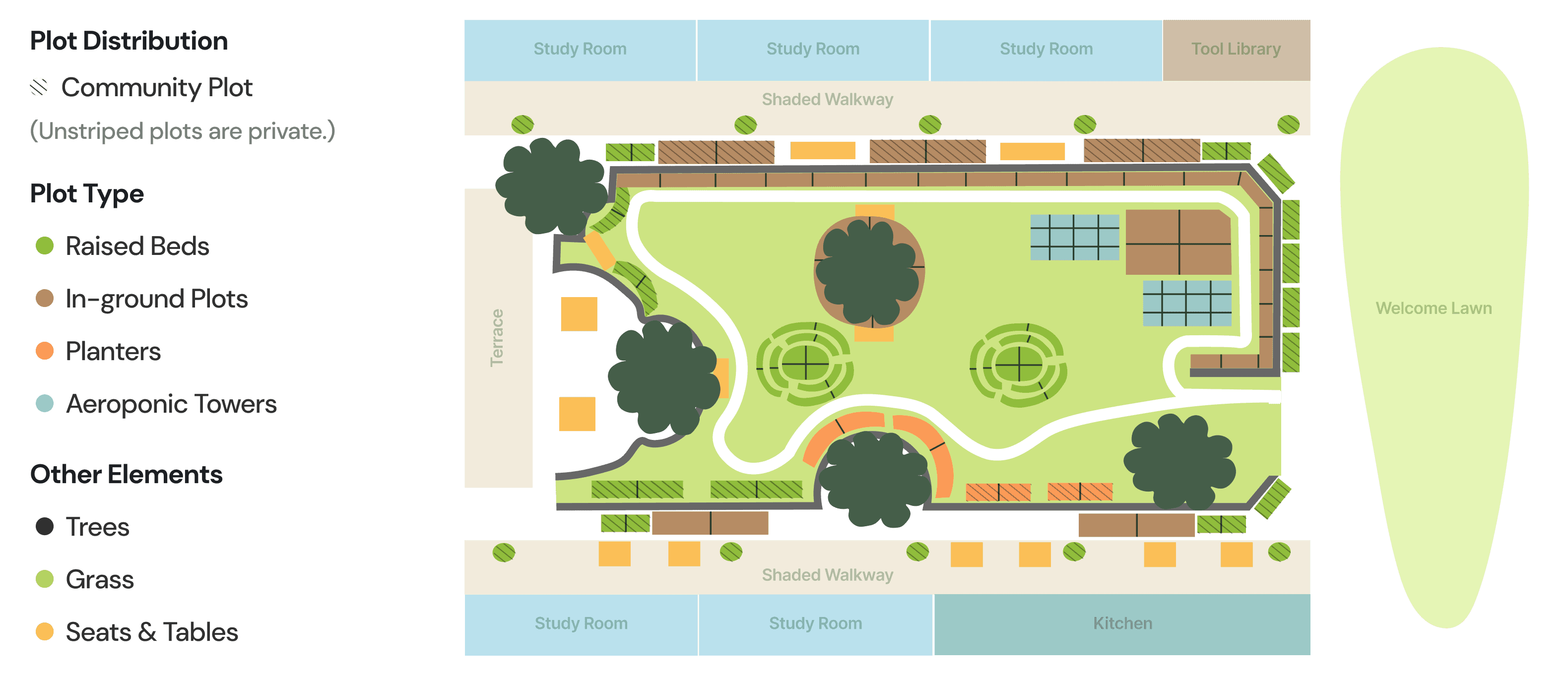
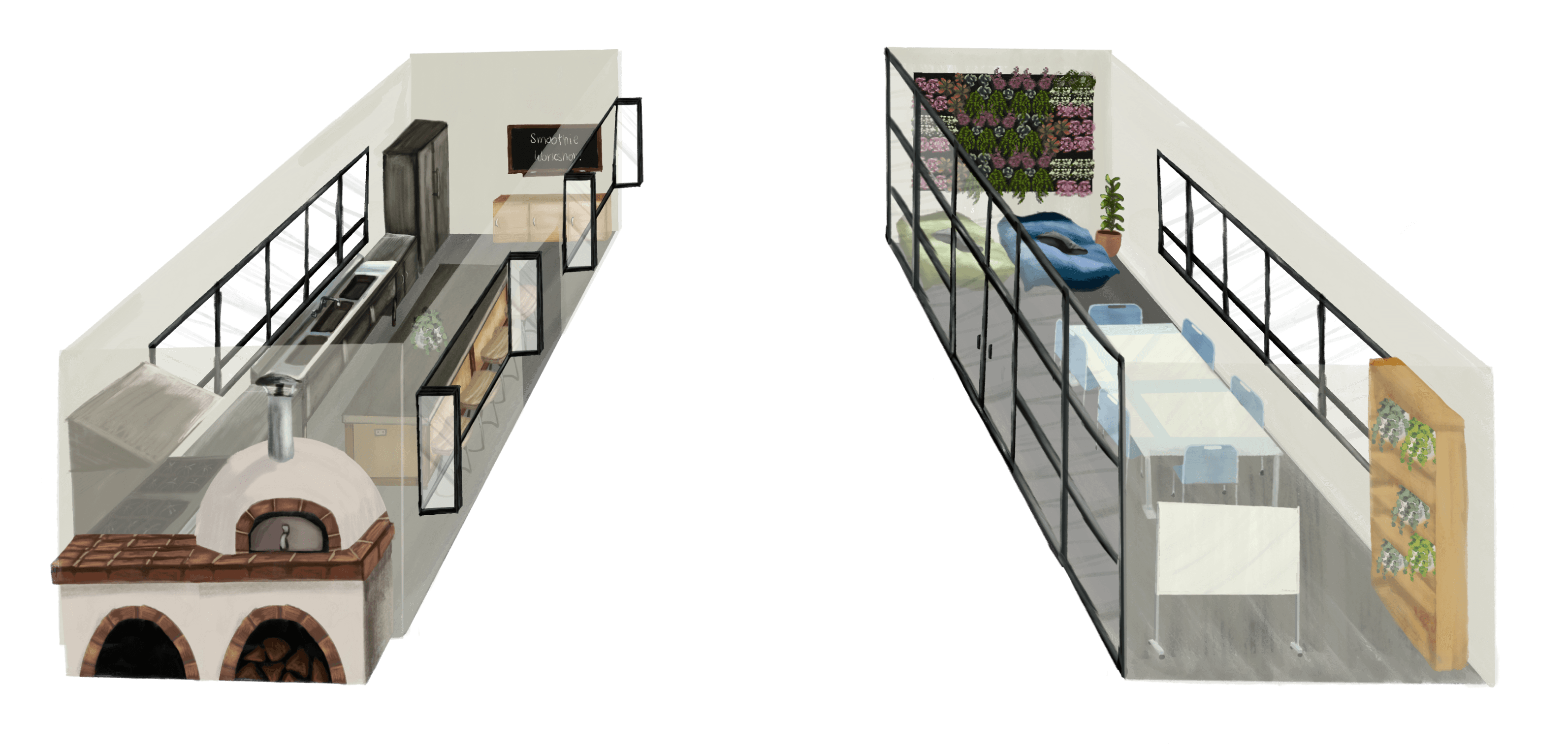
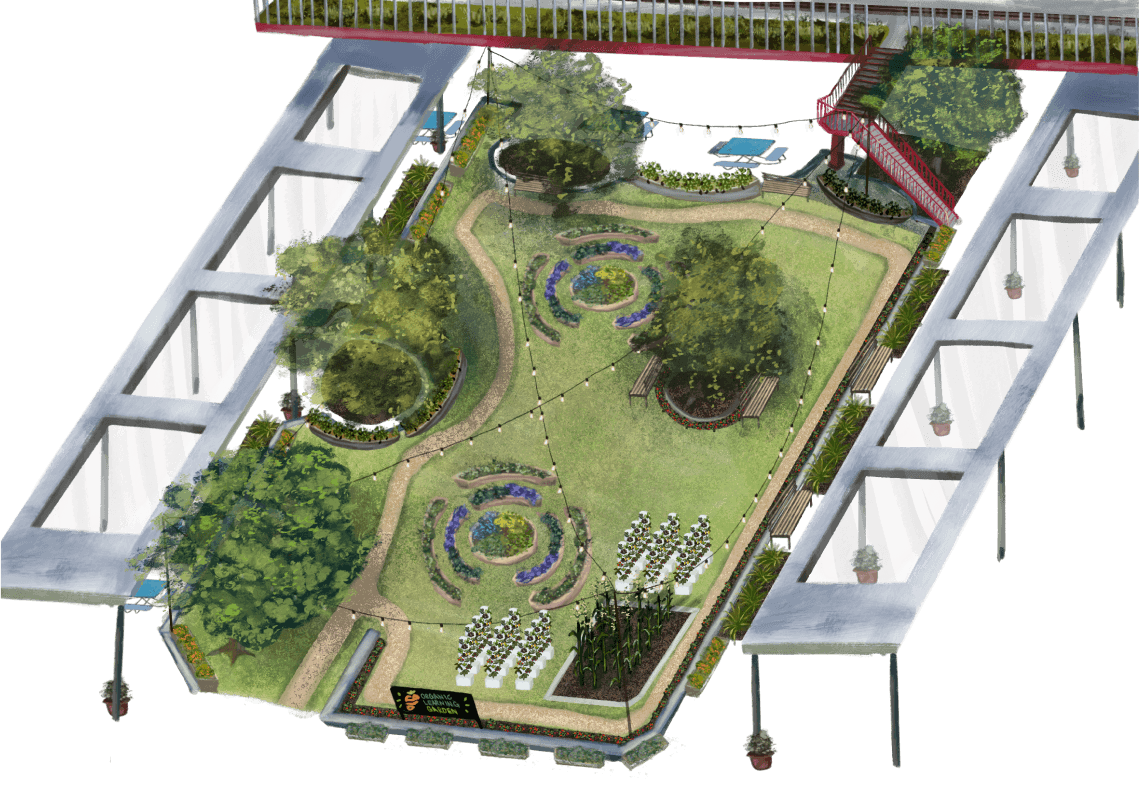
The interim expansion plan repurposes the Art Complex, which will be unused for the next 10 years during campus construction, while preserving existing trees and infrastructure. It introduces more planting spaces, aeroponic towers, accessible paths, shaded seating, and even a pizza oven. Existing art classrooms are reimagined as a community kitchen, study rooms, and a tool library. The concept emphasizes adaptability, reuse, and student-driven growth.
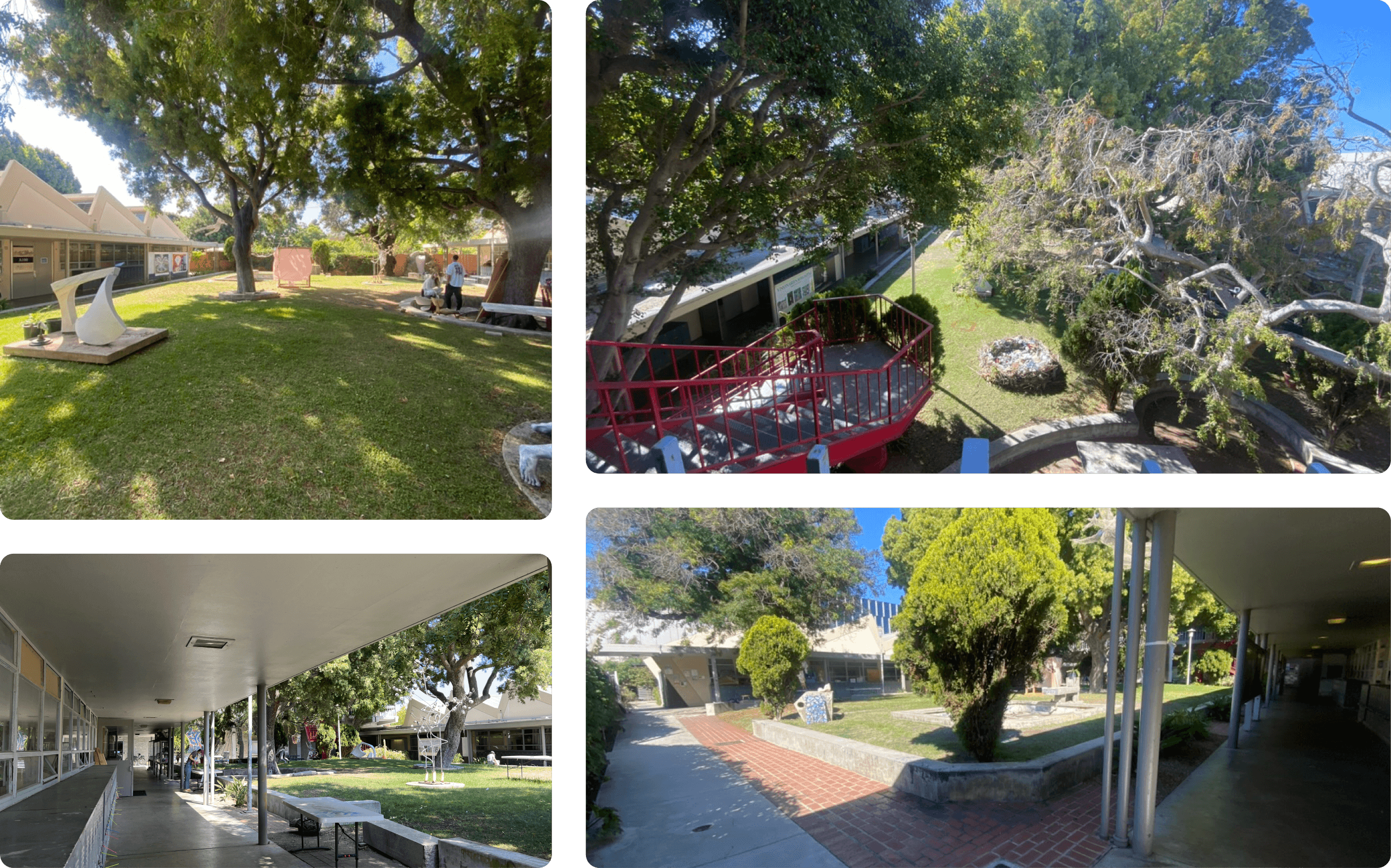
Current Art Complex courtyard adjacent to the garden.

Current Art Complex courtyard adjacent to the garden.

Current Art Complex courtyard adjacent to the garden.

Proposed redesign preserving mature trees, repurposing the unused fountain for planting, and adding raised beds, aeroponic towers, accessible paths, and seating to support expansion.

Proposed redesign preserving mature trees, repurposing the unused fountain for planting, and adding raised beds, aeroponic towers, accessible paths, and seating to support expansion.

Proposed redesign preserving mature trees, repurposing the unused fountain for planting, and adding raised beds, aeroponic towers, accessible paths, and seating to support expansion.

Overhead map showing plot types and garden features.

Overhead map showing plot types and garden features.

Overhead map showing plot types and garden features.

The Community Kitchen features a stovetop, sink, refrigerator, pizza oven, and storage. Study rooms provide quiet spaces with greenery, tables, and comfortable seating.

The Community Kitchen features a stovetop, sink, refrigerator, pizza oven, and storage. Study rooms provide quiet spaces with greenery, tables, and comfortable seating.

The Community Kitchen features a stovetop, sink, refrigerator, pizza oven, and storage. Study rooms provide quiet spaces with greenery, tables, and comfortable seating.

AI prompted by Jordan Budisantoso

10-Year Vision

AI prompted by Jordan Budisantoso

10-Year Vision

AI prompted by Jordan Budisantoso

10-Year Vision

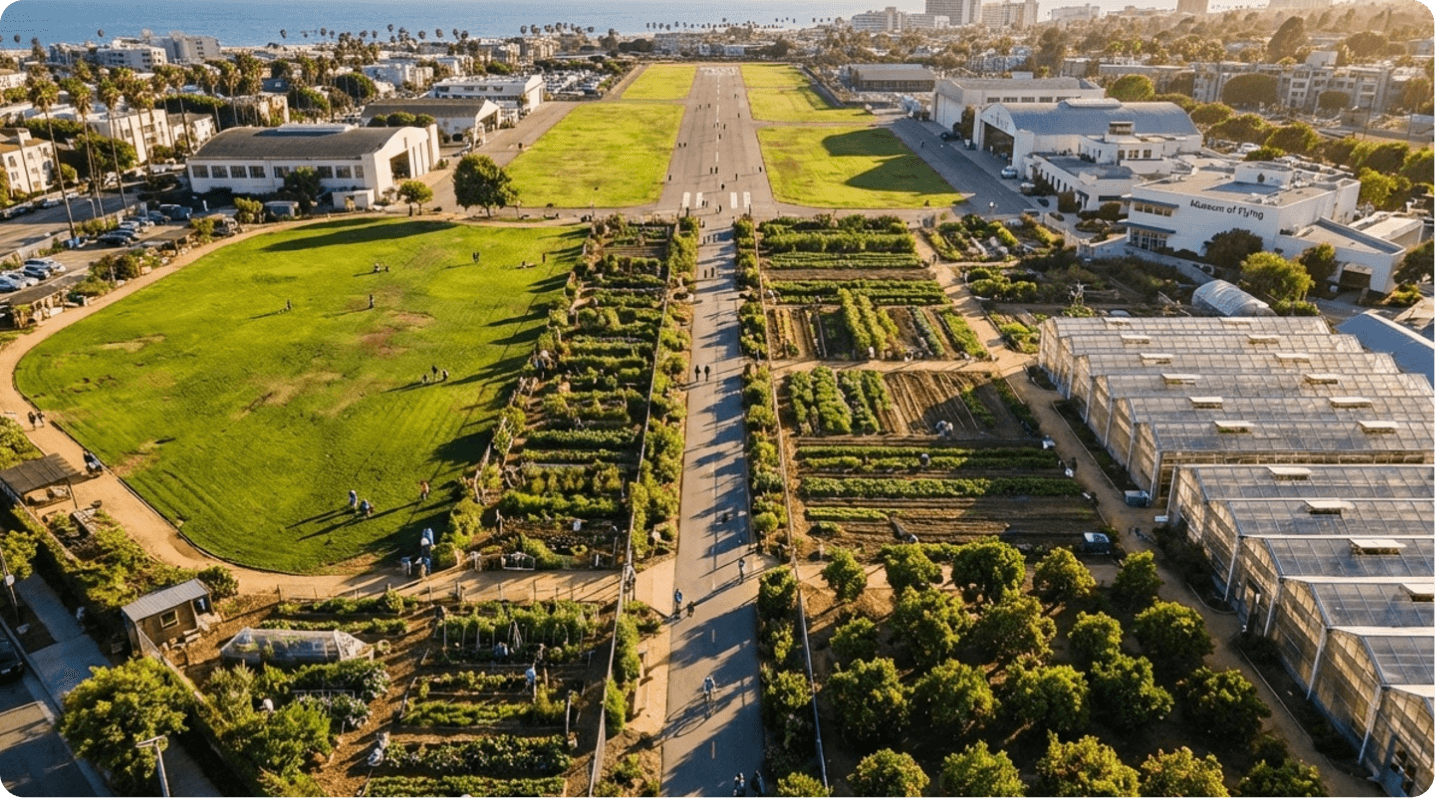
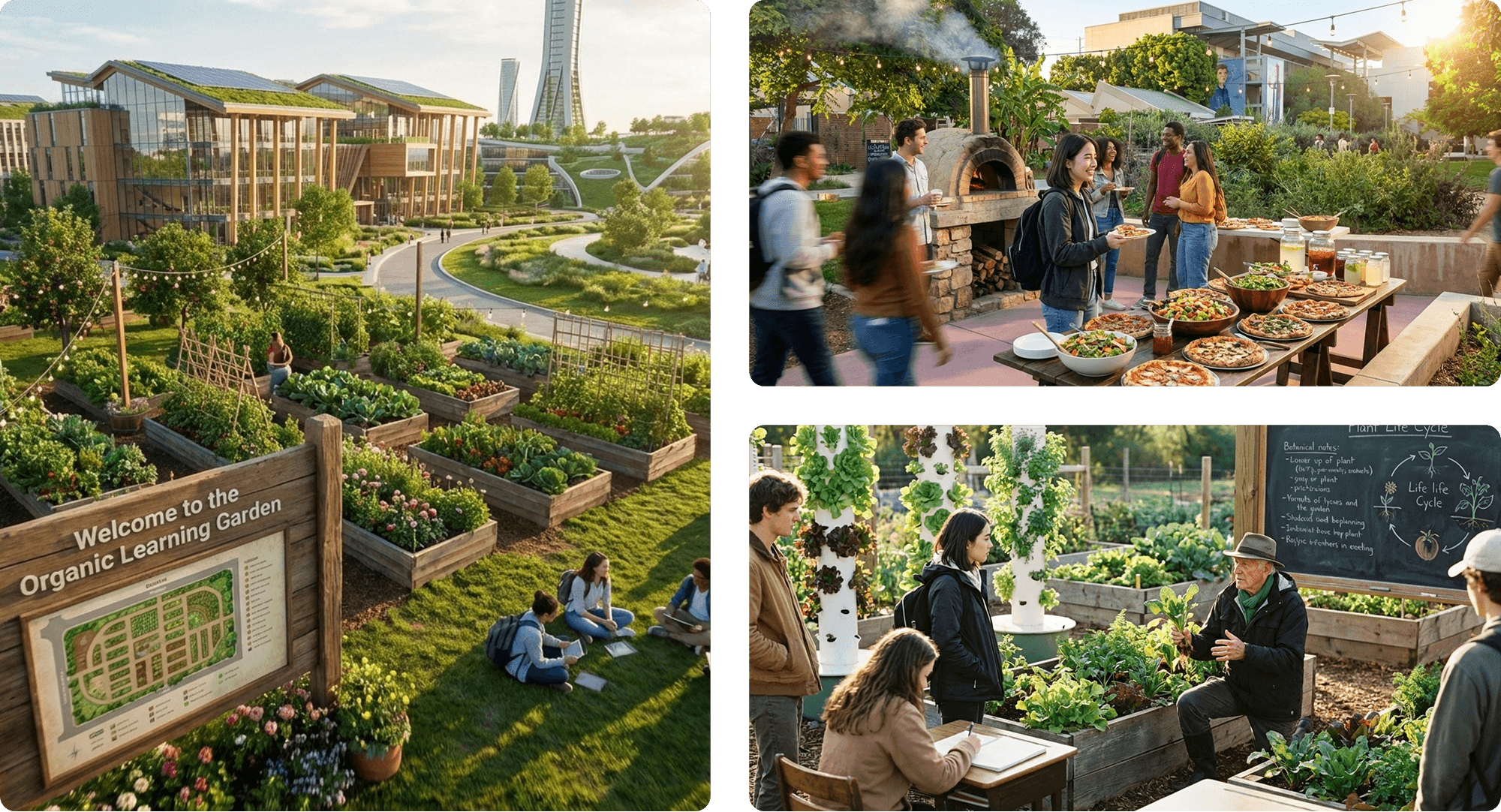
The 10-year vision imagines a fully reconfigured Organic Learning Garden following the demolition of the old Art Complex, featuring outdoor classrooms, greenhouse-inspired gathering spaces, communal cooking, and expanded food production. Beyond campus, the vision extends to the planned closure of the Santa Monica Airport in 2028 as an opportunity for large-scale urban farming and food preservation to support the campus Bodega and address food insecurity at scale.
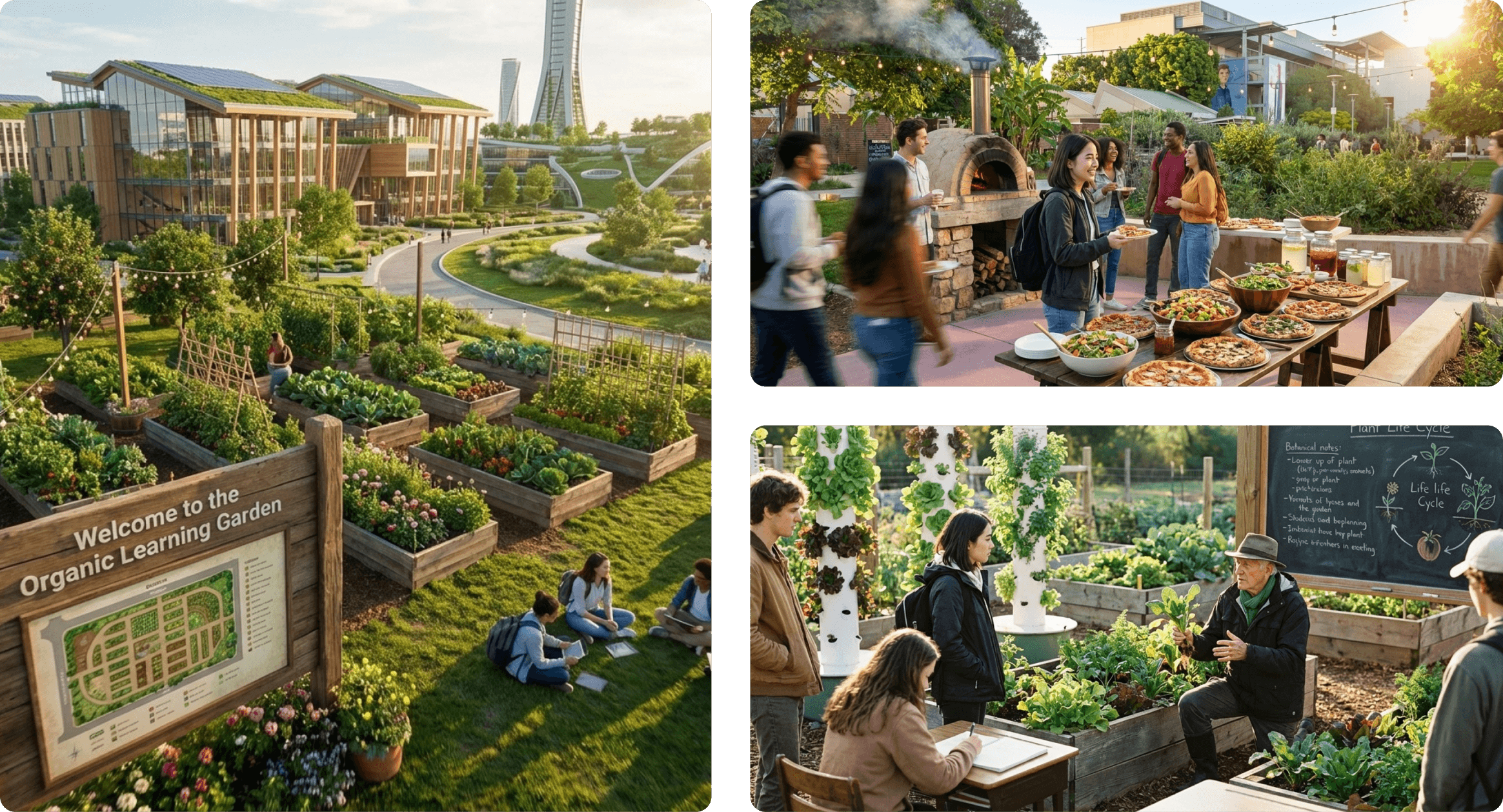
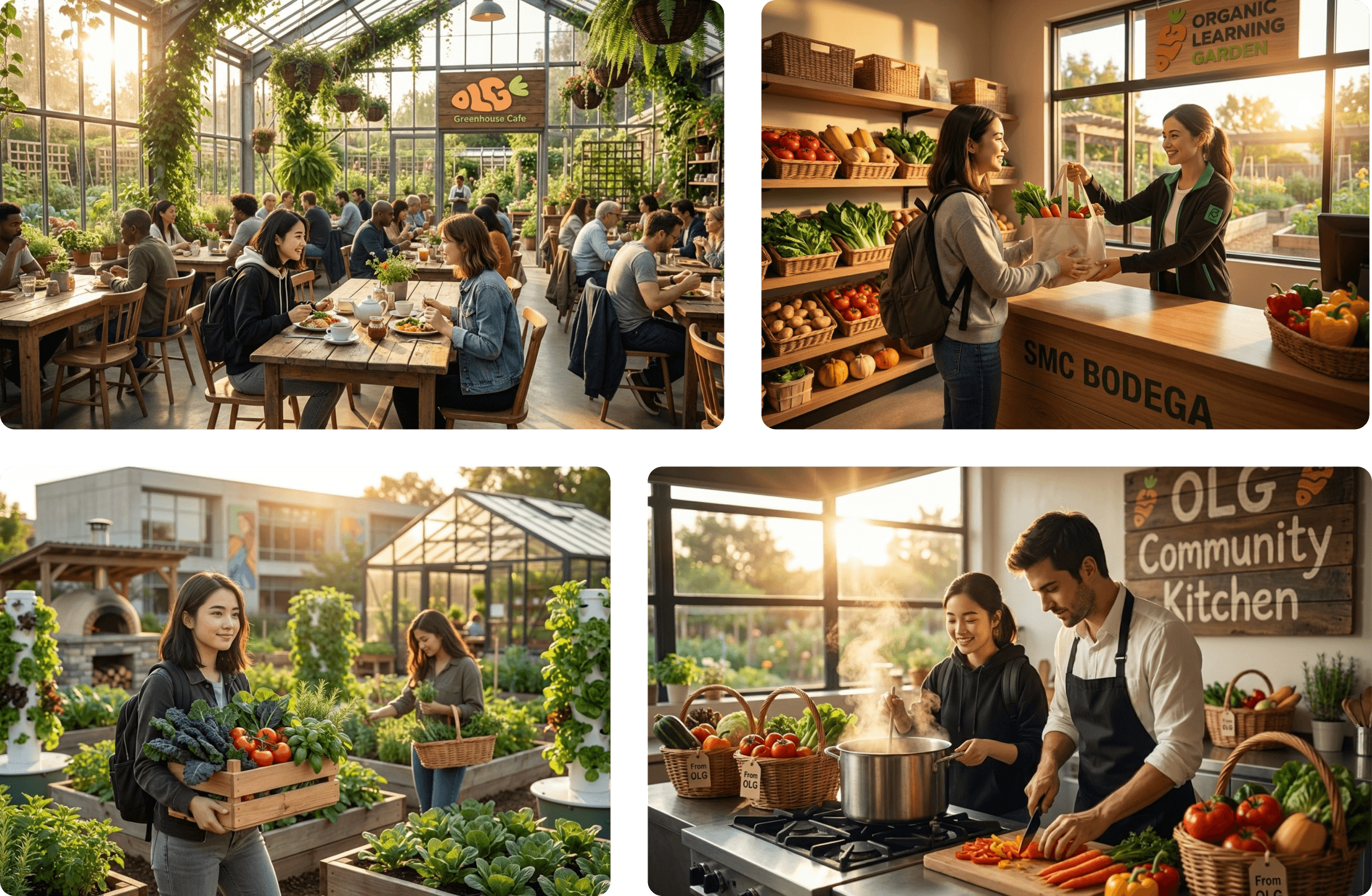
Outdoor eating and learning spaces.

Outdoor eating and learning spaces.

Outdoor eating and learning spaces.

Greenhouse-inspired multifunctional spaces.

Greenhouse-inspired multifunctional spaces.

Greenhouse-inspired multifunctional spaces.

Expanded urban farming at the Santa Monica Airport.

Expanded urban farming at the Santa Monica Airport.

Expanded urban farming at the Santa Monica Airport.

Results & REflection

Results

We successfully translated ethnographic research into a clear, non-intrusive design strategy that earned strong endorsement from garden advisors.

Results

We successfully translated ethnographic research into a clear, non-intrusive design strategy that earned strong endorsement from garden advisors.

Results

We successfully translated ethnographic research into a clear, non-intrusive design strategy that earned strong endorsement from garden advisors.

Although we were unable to conduct user testing with students or garden members, the final feedback from our professors, who are also garden advisors, was overwhelmingly positive. The project concluded with a strong recommendation to pitch the work to the college administration.


I am very impressed [...] Your actual proposed designs are fantastic […] awesome website […] Your ‘get out of the way’ is spot on. You are enhancing the garden environment, not changing the garden vibes that already exist.”

Eric Minzenberg

Anthropology Professor & Garden Advisor

I am very impressed [...] Your actual proposed designs are fantastic […] awesome website […] Your ‘get out of the way’ is spot on. You are enhancing the garden environment, not changing the garden vibes that already exist.”

Eric Minzenberg

Anthropology Professor & Garden Advisor

I am very impressed [...] Your actual proposed designs are fantastic […] awesome website […] Your ‘get out of the way’ is spot on. You are enhancing the garden environment, not changing the garden vibes that already exist.”

Eric Minzenberg

Anthropology Professor & Garden Advisor

The logo feels like it’s been there forever! [...] I love each of your elements, the garden expansion, the website, the logo. [...] real focus and depth from each subgroup [...] I love the website and I think it would benefit the garden hugely to adopt it. I especially like the openness to future additions, it feels expansive.”

Gillian Grebler

Anthropology Professor & Garden Advisor

The logo feels like it’s been there forever! [...] I love each of your elements, the garden expansion, the website, the logo. [...] real focus and depth from each subgroup [...] I love the website and I think it would benefit the garden hugely to adopt it. I especially like the openness to future additions, it feels expansive.”

Gillian Grebler

Anthropology Professor & Garden Advisor

The logo feels like it’s been there forever! [...] I love each of your elements, the garden expansion, the website, the logo. [...] real focus and depth from each subgroup [...] I love the website and I think it would benefit the garden hugely to adopt it. I especially like the openness to future additions, it feels expansive.”

Gillian Grebler

Anthropology Professor & Garden Advisor

Reflection

Third places scale through clarity before construction.

Reflection

Third places scale through clarity before construction.

Reflection

Third places scale through clarity before construction.

This project showed how clear, accessible communication can shift perception and participation in a physical space, even without immediate construction. Addressing informational clarity alongside long-term spatial constraints helped reframe the garden from a niche club space into a major campus third place and resource. Ethnographic research revealed that the garden already supports strong social connection for a small community, reinforcing the importance of designing with—not over—existing practices. Together, these insights shaped an approach to third-place design focused on supportive, capacity-building interventions rather than disruptive change.


Next Steps

Translate concepts into a campus-ready plan.

Next Steps

Translate concepts into a campus-ready plan.

Next Steps

Translate concepts into a campus-ready plan.

Conduct usability testing for the website with garden members and the general student body to improve and expand the design.

Conduct usability testing for the website with garden members and the general student body to improve and expand the design.

Conduct usability testing for the website with garden members and the general student body to improve and expand the design.

Consult gardeners, landscape professionals, and faculty to refine spatial concepts.

Consult gardeners, landscape professionals, and faculty to refine spatial concepts.

Consult gardeners, landscape professionals, and faculty to refine spatial concepts.

Collaborate with campus partners, including the Bodega, cafeteria, sustainability, and entrepreneurship programs.

Collaborate with campus partners, including the Bodega, cafeteria, sustainability, and entrepreneurship programs.

Collaborate with campus partners, including the Bodega, cafeteria, sustainability, and entrepreneurship programs.

Work with college administrators to understand funding, approvals, and technical constraints.

Work with college administrators to understand funding, approvals, and technical constraints.

Work with college administrators to understand funding, approvals, and technical constraints.